At The Visual House, our experience in corporate filmmaking has taught us that a useful shoot plan needs input from the people who know the location best. In a working factory, that means involving the plant team early, alongside marketing and the production agency.
The most impressive machine may run only at certain hours. A process central to your story may happen in a restricted area. And the person best placed to explain your quality standards may have just twenty minutes available between shifts.
These details shape what the crew can capture and how clearly the finished film presents your capabilities. Here are 7 things we recommend planning before a factory shoot.
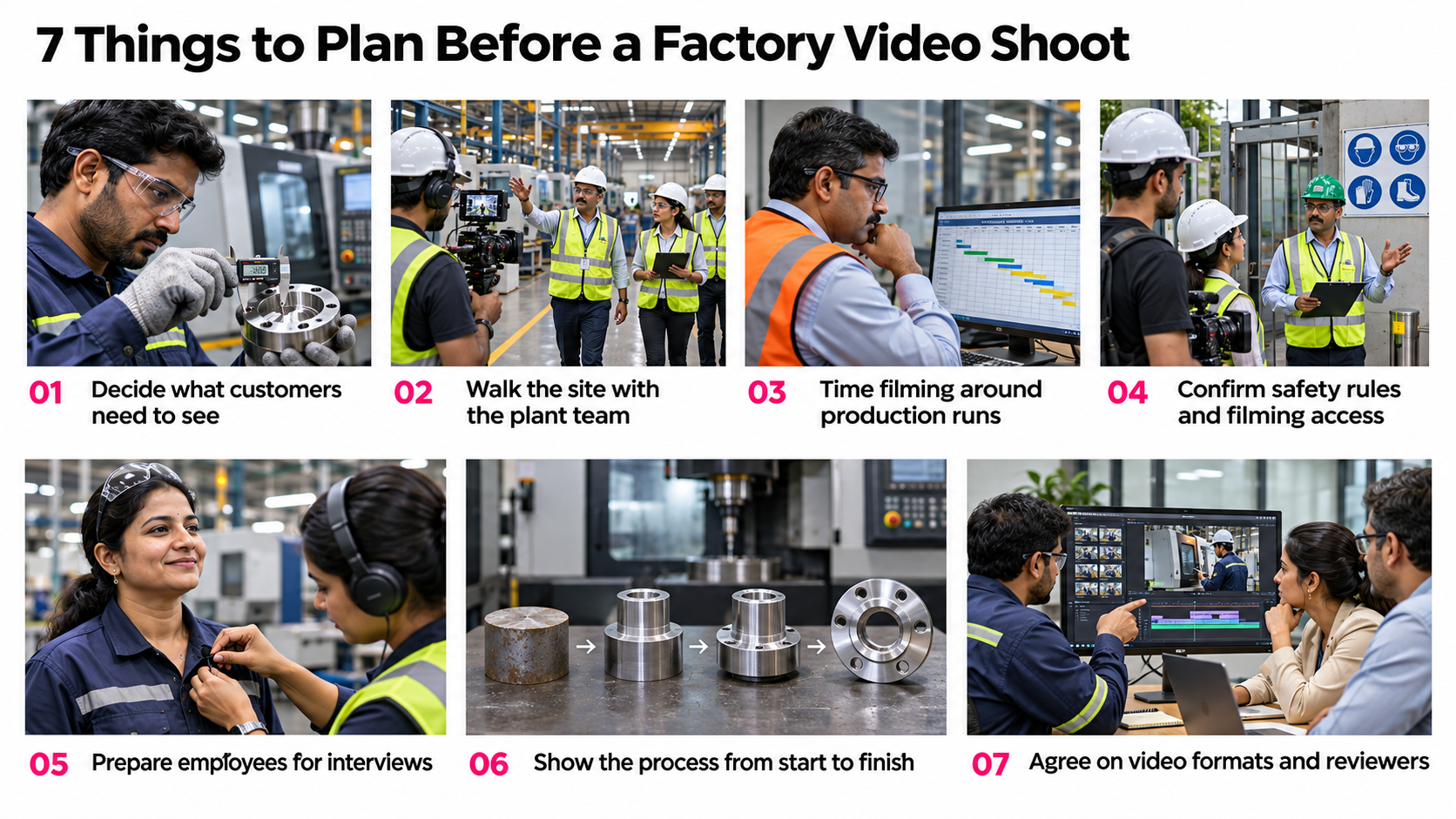
1. Define what customers need to see
Start with the purpose of the film. If it will support sales conversations, identify what potential customers need to understand about your manufacturing capabilities.
That could be your ability to handle large orders, maintain consistent quality or manufacture specialised components. Each message needs something meaningful on screen.
For example, if precision is a key strength, plan to show inspection and testing. If you want to communicate scale, identify the production areas and activity that demonstrate it. This gives the crew a clear reason for every shot.
2. Walk through the facility with the production team
Arrange a site visit before confirming the shoot schedule. Include someone from operations who understands the facility and can explain how work moves through it.
The walkthrough helps the agency assess space, lighting, noise and suitable filming positions. Your factory team can flag restricted areas, busy routes and processes that need special access.
It is also an opportunity to spot details worth filming that may never appear in the company presentation: a testing procedure, a skilled operator’s work or the way finished products are checked before dispatch.
3. Match the shoot schedule to the production schedule
Confirm when the activities you need will take place. A factory may be operational all day, but that does not mean every process will be available whenever the crew reaches it.
If a particular product runs only in the morning, schedule that footage first. If manufacturing takes several hours, the crew may need to capture different batches at different stages.
Agree on a priority list and keep alternatives ready. An interview or product shot can fill a gap if a process is delayed. Nominate one factory coordinator to help manage access and changes throughout the day.
4. Get safety and filming permissions agreed in advance
Share the proposed filming areas and activities with your site safety and security teams. Confirm entry requirements, protective equipment, supervision and where cameras or lights can be positioned.
Any filming request that affects machinery or normal operations should be handled by authorised factory personnel.
Confidentiality needs the same attention. Customer labels, drawings, screens and prototypes may appear in the background. Identify what cannot be filmed and brief the crew before the shoot begins.
Planning a film at your manufacturing facility?
TVH can help turn your communication brief into a practical shoot plan.
Discuss your factory shoot
5. Prepare the people who will appear on camera
Tell employees what is being filmed, why it matters and what their involvement will be. Arrange the necessary permissions and coordinate participation with their supervisors.
For interviews, share the discussion topics in advance. Encourage people to explain their work in language they use every day, with examples where helpful.
A quality manager describing how a component is checked can offer more substance than a general statement about “commitment to excellence.” Give them time to answer comfortably, and choose a quieter location if the factory floor makes conversation difficult.
6. Capture a process viewers can follow
A sequence of large machines can look impressive while leaving viewers unsure about what the company actually does.
Help your agency understand the stages that matter: where materials enter, how they are processed, what checks take place and how the finished product leaves the facility.
The film does not need to document every step. A few well-chosen moments can make the work understandable. Combine views of the facility with closer details of people, products and processes so the editor has material that connects the story.
7. Plan the final uses and review process
Confirm the required outputs before filming. A main corporate film, a short sales edit and recruitment clips may need different footage, even when captured during the same visit.
Agree on who will review the edit, too. Marketing should check the message and brand presentation, while an operations representative verifies process accuracy and checks for confidential information.
Consolidate that feedback through one person so the production team receives clear instructions.
Give the crew the context behind the factory
Your factory team knows why a process matters. Your production agency knows how to make that process understandable on screen. Bringing that knowledge together early helps the shoot run smoothly and gives the finished film substance.
At The Visual House, our corporate video production process brings communication planning and filmmaking together, shaping the shoot around what your audience needs to see.



.jpeg)
.jpeg)

.jpeg)
.jpg)


.jpg)




.png)


.jpg)
.jpg)
.jpg)



.jpg)

.jpg)



.jpg)




.jpg)
.jpg)
.jpg)
.jpg)

.jpg)
.jpg)
.jpg)
.jpg)
.jpg)
.jpg)
.jpg)
.jpg)
.jpg)
.jpg)













.jpg)



.jpg)
.jpg)
.jpg)

.jpg)
.jpg)
.jpg)


.jpg)
.jpg)













.jpg)
.jpg)
.jpg)

.jpg)
.jpg)
.jpg)
.jpg)











.jpg)
.jpg)
.jpg)
.jpg)
.jpg)
.jpg)

.jpg)
.jpg)
.jpg)
.jpg)
.jpg)
.jpg)
.jpg)
.jpg)
.jpg)
.jpg)
.jpg)
.jpg)








.jpg)
.jpg)